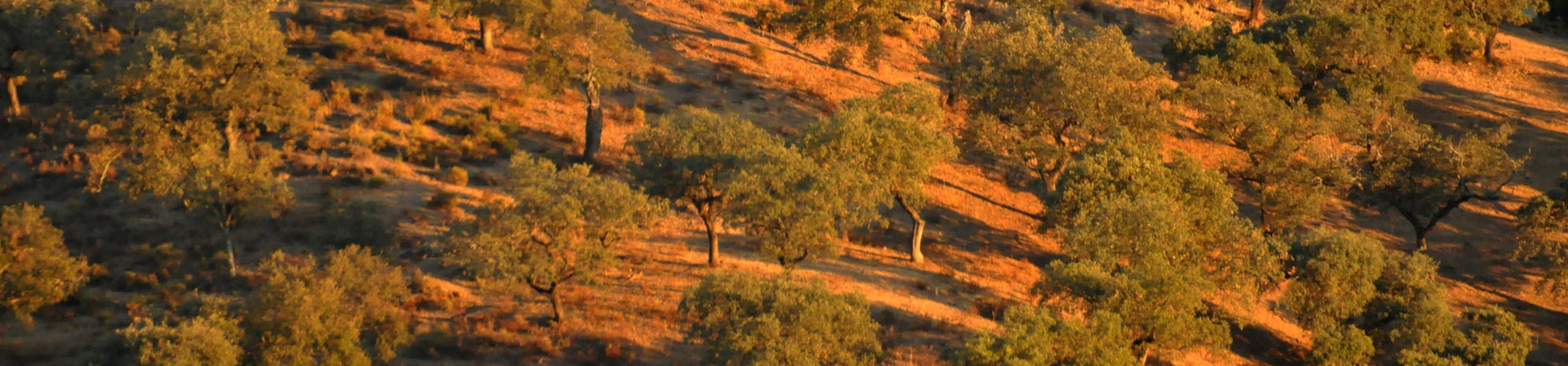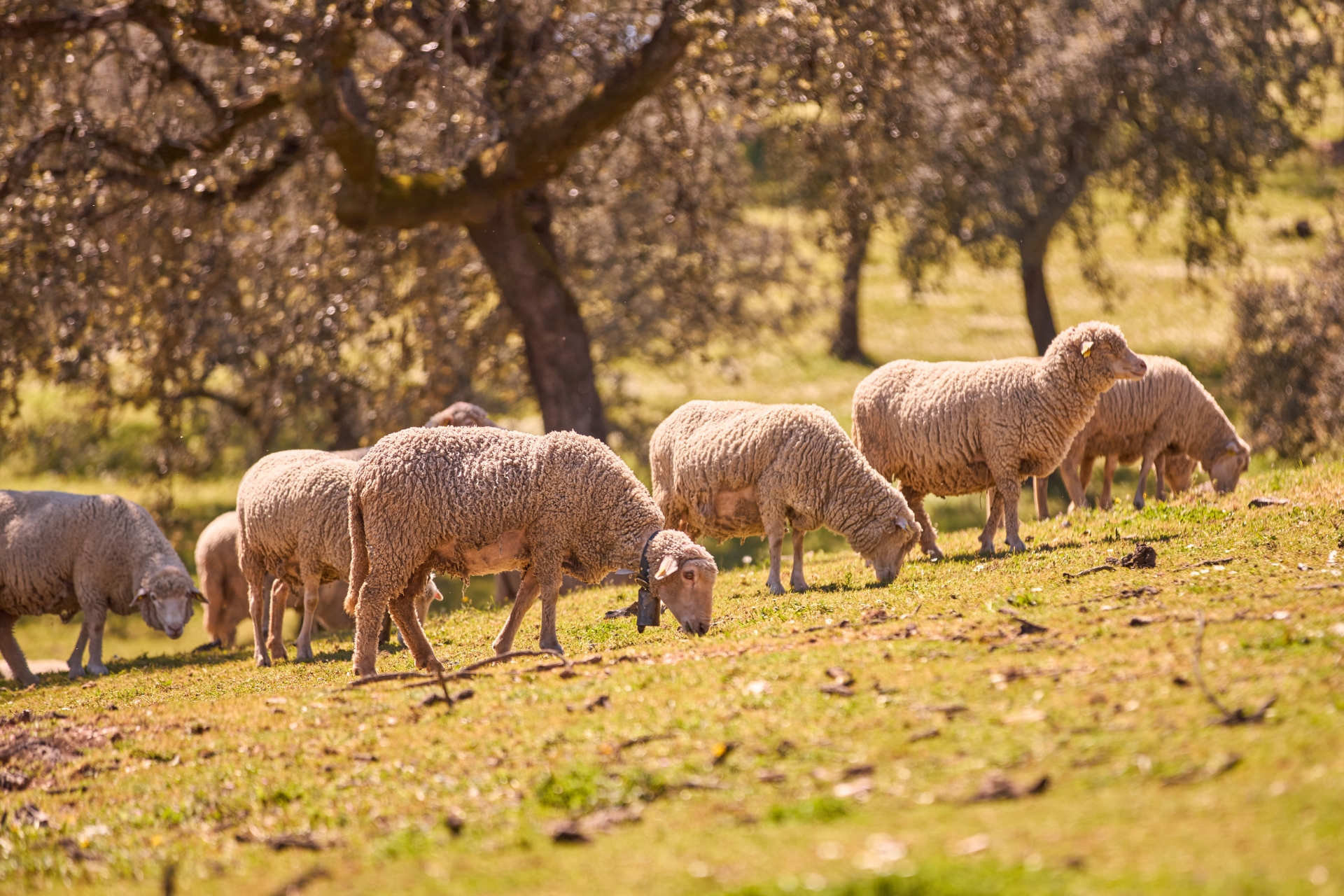
Ernestine Lüdeke walks through the dehesa as if
tending a fragile treasure: she knows that every sheep grazing here not only
feeds, but also clears the undergrowth, fertilizes the soil, and helps prevent
fires that could devour everything. Through the Monte Mediterráneo Foundation,
she defends transhumance — an ancestral system linking south and north,
biodiversity and economy—which today proves essential in combating
desertification and rural abandonment.
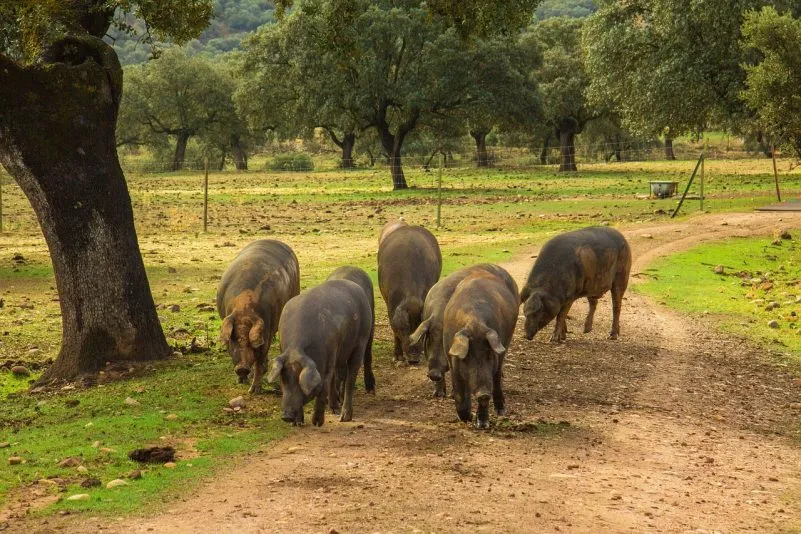
The dehesa is
a human-shaped silvopastoral ecosystem, developed over centuries from
Mediterranean forest into a productive system. Shrubland was cleared and the
woodland was opened up, selecting holm oaks and cork oaks that provide shade, a
suitable microclimate and acorns for extensive livestock farming. This balanced
management has enabled the use of grazing land, cork, fuelwood, and hunting,
shaping a multifunctional system that combines ecological sustainability with
rural production. Illustrative image. JamonSeleccion. Pixabay.
Spain hosts a singular ecosystem, shaped by
human activity over centuries with both purpose and wisdom. The dehesa—an
agro-silvopastoral landscape par excellence—has guided human activity toward an
ancestral form of sustainability, where selective hunting, extensive livestock
farming, wood collection, cork harvesting, and acorn grazing coexist in
equilibrium with the land and the rhythms of time.
Ernestine Lüdeke, president of the Monte
Mediterráneo Foundation, explained to The Epoch Times España that the
dehesa is an agroecosystem born from the native Mediterranean woodland, which
has been transformed by removing scrub and selecting productive tree species.
Lüdeke noted that about two millennia ago, as
populations became sedentary, part of the woodland was cleared. This allowed
abundant pasture to grow beneath the remaining trees, benefiting from the shade
they provide in summer and the milder microclimate they create in winter, as
well as from acorns used to feed pigs. Communities also began practicing
pastoral livestock farming, gradually refining the system into what we now know
as the dehesa.
Established in 1993, the Monte Mediterráneo
Foundation has focused on the conservation, sustainable management, and
promotion of the Mediterranean dehesa ecosystem. According to Lüdeke, the
dehesa—often described as the last barrier against desertification due to its
resemblance to the African savanna—is an extremely delicate ecosystem. Its
vitality and balance depend on the continuous interaction between wildlife and
extensive livestock farming, which keeps the landscape open, enriches the soil,
and preserves biodiversity.
“As a system built from many small components,
it doesn’t work like a simple pasture with dairy cows: cows graze and are then
kept indoors in winter. Here, it’s different. Here, sheep graze the grass while
it is still short.”
“Then, as the grass grows taller, it has to be
eaten by cattle, since sheep don’t graze tall grass or don't like it. It must
also be kept clear so that when acorns fall, pigs can reach them and feed on
them together with some grass. And in summer, we have neither water nor food.
That’s where the idea of moving the sheep comes from,” Lüdeke explained.
Lüdeke noted that this practice has been
carried out for a thousand years, requiring sheep in winter and spring to act
as natural landscapers. Through manure and light trampling, they maintain the
agroecosystem without compacting the soil, unlike heavier livestock. In summer,
however, they become surplus due to the lack of resources, and the system
traditionally functioned in connection with the northern mountains.
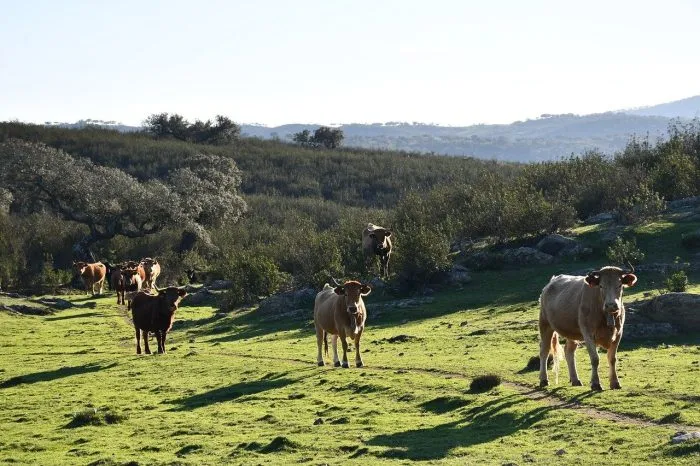
Here,
livestock graze beneath holm oaks that provide shade and acorns. The dehesa: sustainability
inscribed in the landscape. Illustrative image.
Photo:
PABLOGOMEZFOTOGRAFIA, Pixabay.
In the past, extensive livestock systems driven
by transhumance maintained a perfect balance between the Mediterranean dehesa
and the northern mountains—such as the Cantabrian Range, the Picos de Europa,
the Iberian System, and regions like León, Palencia, and Zamora. As there was
not enough water or pasture for livestock in the dehesa during summer, it was
temporarily left without grazing animals; therefore, transhumant flocks
travelled along livestock routes and drove roads toward northern mountain pastures,
where they found fresh, dense, and nutritious high-altitude grazing.
Extensive grazing, promoted by traditional
livestock systems such as transhumance, has a positive impact on ecosystem
sustainability. Herds function as natural firebreaks, removing built-up biomass
that would otherwise serve as fuel for forest fires, further intensified by
droughts and periods of intense heat.
According to Lüdeke, the main factor behind the
recent rise in large-scale wildfires in rural Spain is the shift in ecosystem
management. This shift began when transhumance was abandoned and replaced by
sedentary extensive livestock systems, where different types of livestock are
no longer used seasonally.
“The main fires last year were in the north,
weren’t they? Very unusual, because they used to happen here in the south. So
wherever transhumant sheep have disappeared, millions and millions of sheep
have disappeared.”
The Monte Mediterráneo Foundation has launched
a proposal called Caminos Trashumantes, a project dedicated to promoting
transhumance and connecting the general public with this extensive livestock
practice. Its objective is to help people appreciate the value of this living
cultural heritage embodied in this millennia-old practice, as well as the
cultural activities derived from it, which also have a positive impact on
environmental and territorial sustainability.
According to the project’s website, “the
initiative includes guided routes, craft workshops, visits to livestock farms,
educational activities, local fairs, gastronomy, and much more. All of them are
connected by a common thread: transhumant culture and its environment.”
“It brings together gastronomy, textiles,
ecology, biodiversity, rural depopulation, vocational training for shepherds,
and more—it covers many different areas,” Ernestine explained.
These types of projects bring to the forefront
the value of transhumance in Spain as something far beyond livestock
management: it is a way of life that has shaped rural landscapes, supported
local economies, and preserved deep-rooted traditions.
Transhumance and traditional dehesa management
are not relics of the past but living tools to combat desertification,
large-scale wildfires, and rural depopulation. Projects like Caminos
Trashumantes invite us to reconnect with this living heritage: to walk these
drovers’ roads, to value the wool, meat, and cheese it produces, and to support
the shepherds who continue to uphold it.
The balance that sustained this ecosystem for
centuries depends on making the right choices: responsible consumption,
supportive policies that protect extensive livestock systems, and ensuring the
dehesa does not become a memory.
Biodiversity conservation, especially the
balance and sustainability of wild species in the dehesa, is also a priority in
the foundation’s work. This is evident in initiatives such as the 2016
Bioblitz— which recorded a biodiversity record that still stands— as well as in
the daily management of the ecosystem, where efforts focus on integrating
extensive livestock grazing, soil conservation, and the protection of native
wildlife.
Bioblitz is a 24-hour event inspired by
National Geographic’s Geo Day, during which participants carry out an inventory
of wild species within a defined area. The data collected is incorporated into
global databases and has achieved a record level of biodiversity.
“For ten years, no one has exceeded our
record—we achieved the highest biodiversity. The catalogue is scientific, as a
research team verifies that what is recorded is accurate. There were 125 people
working in the field for 24 hours gathering data.”
César Múnera