Dehesa San Francisco Estate,
Sierra de Aracena (Huelva)
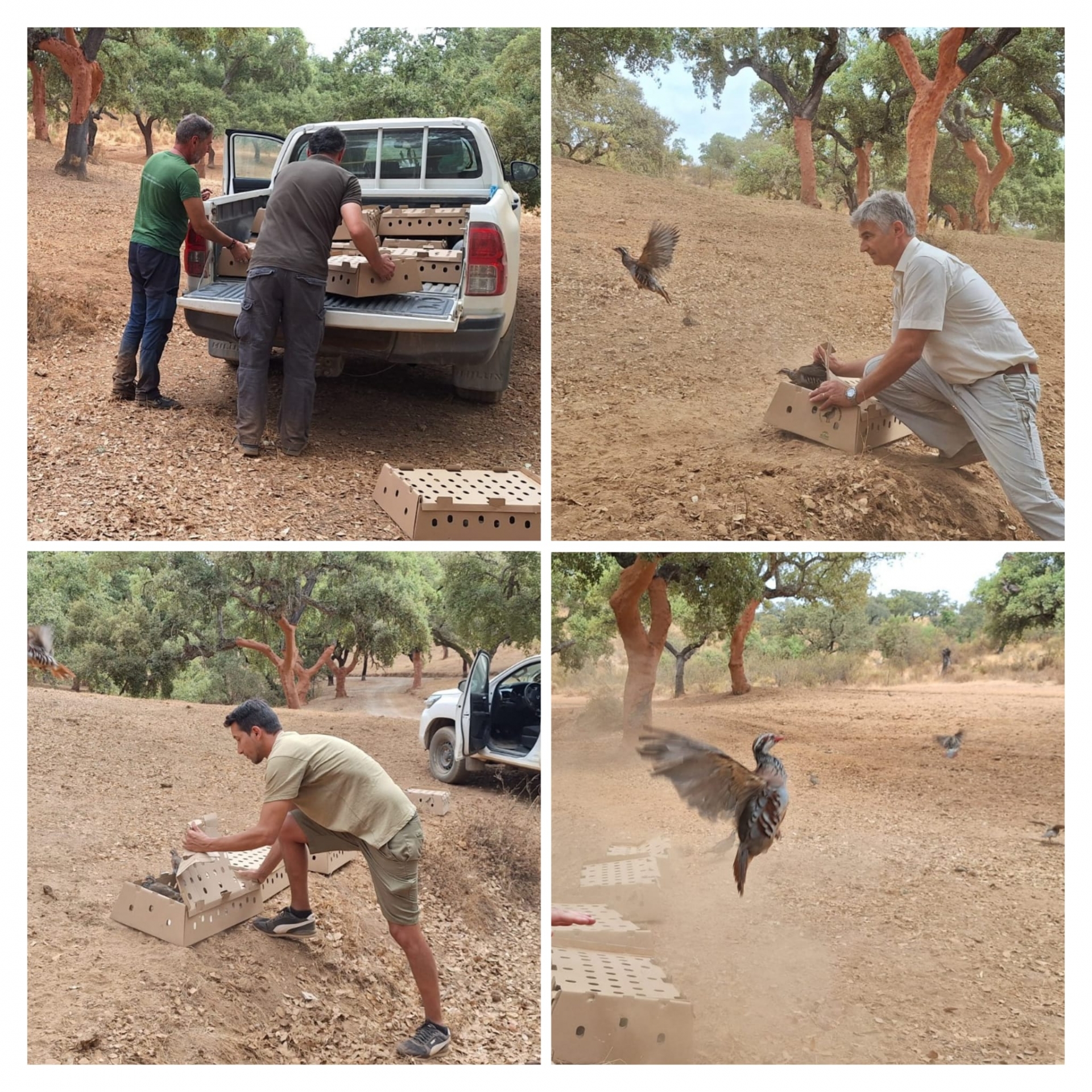
A new biodiversity conservation action has
taken place at the Dehesa San Francisco estate, managed by the foundation
Fundación Monte Mediterráneo, with the release of 150 wild red-legged
partridges in the surroundings of the Sierra de Aracena and Picos de Aroche
Natural Park.
This initiative, the result of public-private
collaboration, is part of an agreement aimed at enhancing biodiversity and
promoting the presence of emblematic species such as the Spanish imperial
eagle, which has been observed hunting in the area.
Collaborative effort
The activity brought together representatives
from the Regional Ministry of Sustainability and the Environment, technical
staff from the Estación de Referencia de la Perdiz Roja (Lugar Nuevo Reference
Station in Jaén), the park’s conservation director, the management team of the
Monte Mediterráneo Foundation, and local hunters committed to wildlife
conservation.
The partridge: a key prey for the imperial
eagle
The red-legged partridge plays a crucial role
in the diet of the Spanish imperial eagle, especially in areas where wild
rabbit populations have declined or disappeared due to recurrent outbreaks of
viral hemorrhagic disease (VHD). In these situations, the eagle broadens its
diet to include crows, reptiles, carrion, pigeons, and partridges.
For this reason, controlled releases like this
one are essential to increase the availability of natural prey and to improve
breeding success in historical nesting areas.
Wild partridges with monitoring and guarantees
The released partridges come from the regional
breeding station at Lugar Nuevo, where they are raised under strict genetic and
health protocols. These are young birds from the same breeding season, which
helps their adaptation and survival in the wild.
The releases are carried out using a “hard
release” method (without acclimatization cages), supported by feeding and
watering points. Long-term monitoring with colour rings has shown that many of
these birds survive well, integrate into local flocks, and can travel several
kilometres from the release site.
A commitment to active land management
This release highlights how sustainable game
and livestock management—combined with the support of public institutions—can
generate tangible benefits for the conservation of endangered species like the
Spanish imperial eagle, while enhancing biodiversity in Andalusia’s rural
landscapes.